
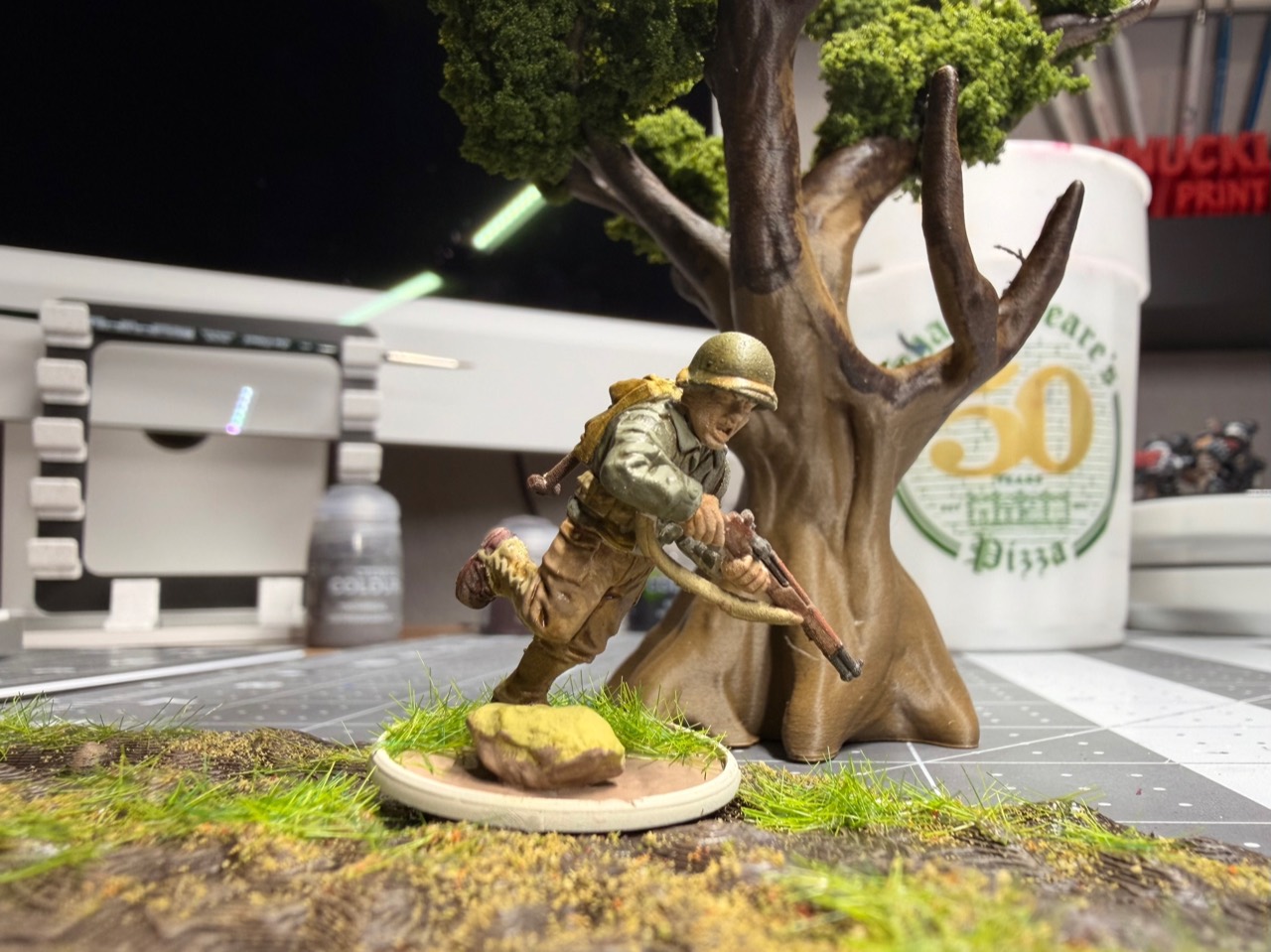
If you buy a 28mm miniature, there is no guarantee that it will measure 28mm tall.
It may be 28mm to the eyes. It may be 28mm to the top of the head. It may stand 32mm tall but have the hands of a much larger person. Sometimes “28mm” simply means that the manufacturer believes it will look acceptable near other products that also say 28mm.
This is not especially helpful when you are about to purchase an army, print fifty tiny soldiers or build an entire town around them.
The short answer is that miniature scale labels are useful categories, not dependable physical standards. If you need two ranges to match, you have to look beyond the number on the package.
Where is the 28mm measured?
Traditionally, many historical wargaming figures are measured from the bottom of the feet to eye level.
The idea makes some sense. Helmets, hats, hair and decorative headgear can add several millimeters without changing the intended size of the person underneath. Eye height gives sculptors and players a repeatable anatomical landmark.
Except not everyone uses it.
Other manufacturers measure the complete figure from the feet to the top of the head. Digital sculptors may list the total height of the STL. Some stores use the size category supplied by the designer without explaining how it was measured at all.
This means a figure measuring 28mm to the eyes could stand roughly 30 to 32mm tall. Another figure advertised as 28mm may literally be 28mm from its boots to its bare head.
Both boxes say 28mm. The models can still look noticeably different.
The problem becomes even worse when someone tries to translate the label into a traditional modeling ratio.
You will often see 28mm described as approximately 1:56 scale. That can be a reasonable estimate if the original measurement represents the eye height of an average adult. If 28mm represents the person’s complete height, the resulting ratio is closer to 1:64.
That is a fairly large difference for two calculations that began with the same number.
Heroic scale has entered the chat
Height is only part of the problem.
Many gaming miniatures use heroic proportions. Heads, hands, weapons, feet and important equipment are enlarged so that the figure remains readable from across the table. These features are also easier to manufacture, paint and handle without snapping something every time the model leaves its storage box.
Reaper, for example, openly describes many of its fantasy figures as 28mm Heroic Scale. The “heroic” part matters just as much as the 28mm.
Place a realistically proportioned 28mm historical soldier beside a heavily stylized 28mm fantasy figure and they may reach roughly the same height. One can still look like the other model’s exhausted younger brother.
Neither sculpt is necessarily wrong. They were designed for different visual languages.
This is why changing the height of an STL does not automatically make it match another range. Scaling a realistic figure from 28mm to 32mm makes it taller. It does not give the figure a larger head, thicker limbs or an enormous sword.
Scale and proportion are related, but they are not interchangeable.
Then there is scale creep
Miniature ranges tend to grow.
Sometimes a company introduces newer sculpts with more detail and slightly larger proportions. Sometimes larger figures simply look more impressive in product photography. Digital sculpting also allows details that would have been difficult to produce consistently in older metal ranges.
The result is that an older 28mm figure may be smaller than a newer figure sold for the same game. A product described as 28mm, 30mm, 32mm or even 35mm may be considered compatible depending on the sculpting style.
There is no miniature police force measuring every model before it reaches the store. Manufacturers are trying to communicate where a product belongs in the hobby, but the label alone cannot tell you exactly what will arrive.
A recent discussion in r/wargaming produced nearly every common explanation: 28mm to the eyes, 28mm to the head, 1:56 scale, 1:64 scale and the general conclusion that the number is sometimes based more on compatibility than measurement.
The confusion is not limited to new hobbyists. The terminology itself is inconsistent.
Terrain follows its own rules
Buildings and vehicles introduce another layer of trouble.
A completely realistic building can be inconvenient on a gaming table. Its rooms may be too small for based figures. Its doors may not accommodate raised weapons. Its upper floors may be difficult to reach, and its staircase may occupy more space than the actual fight taking place inside.
Terrain designers often compress the building’s footprint while enlarging doors, windows and playable spaces. This produces something that looks correct beside the miniatures and works during a game, even if an architect would have questions.
Corvus Games Terrain provides an excellent example of how complicated compatibility can become. Its printable gas station uses a rendered figure described as 28mm to the eyes, but the product notes also recommend scaling the terrain to 126 percent for compatibility with a larger superhero game. Both pieces of information appear on the same product page.
That is not a mistake. It is an honest acknowledgment that “28mm terrain” cannot perfectly serve every game placed somewhere under the expanding 28mm umbrella.
Vehicles can be even more noticeable. A slightly undersized building often looks fine because we expect buildings to vary. A supposedly 1:56 truck may look strange when a heroic infantry figure standing beside it has hands wider than the door.
The most important measurement is not always the official ratio. It is whether the important parts look convincing together.
How to tell if two ranges will match
Before buying or printing an entire force, start with an ordinary standing figure.
Do not use a crouching model, mounted character, banner bearer or someone holding a sword directly over their head. Measure from the bottom of the feet to the eyes or the top of the head, then use that same convention for the comparison model.
After checking height, look at:
- Head size
- Shoulder width
- Hand and weapon size
- Limb thickness
- Sculpting style
- Base height
- The amount of detail exaggerated for painting
Comparison photographs are more valuable when the models stand on equally thick bases and the camera is level with them. A taller base or low camera angle can make a small difference look much larger.
For STL files, measuring the imported model directly is safer than trusting the advertised scale. Choose a figure that represents the range well, compare it with a miniature you already own and calculate the percentage from the actual measurements.
The formula is:
Target size ÷ current size × 100
To resize a literal 28mm figure to 32mm:
32 ÷ 28 × 100 = 114.3%
Our miniature scale calculator handles the calculation and includes common conversions, but the result is still a starting point. A mathematically perfect conversion cannot correct different heroic proportions.
Print one model before printing the regiment. This is one of those lessons that sounds insultingly obvious right up until you are looking at fifty tiny giants.
My 15mm army became a 13.5mm army
I ran into the same issue while preparing an American Revolutionary War project.
The original figures were designed at approximately 15mm, but I wanted to test them at 13.5mm. That conversion is straightforward:
13.5 ÷ 15 × 100 = 90%
I reduced the files uniformly to 90 percent and printed samples.
The calculation worked, but the test print was still the important part. I needed to see whether the weapons remained printable, whether the infantry looked right on the intended bases and whether a mounted figure could survive the FDM process at that size.
One of the horses repeatedly curled into the nozzle. Solving that required a cooling tower, not another scale calculation.
That is the limitation of every conversion chart. It can tell you how large the file will become. It cannot tell you whether the sculpt will print cleanly, match another manufacturer’s proportions or look good when thirty models are standing in formation.
Only a test model can do that.
The number is a starting point
Miniature scale does not need to be perfectly scientific.
A tabletop army is a visual collection, not an engineering diagram. Small differences tend to disappear when the painting, basing and overall presentation are consistent. Two ranges do not need identical measurements to look good together.
The label is still useful. A 15mm soldier is obviously intended for a different kind of table than a 75mm display figure. Problems begin when we expect labels such as 28mm and 32mm to provide more precision than the hobby has ever agreed to give them.
Use the advertised scale to narrow the search. Then measure the actual model, compare its proportions and print or buy one representative figure before committing to the rest.
“28mm” may not mean 28mm.
Somehow, that is normal.
Sources and useful links
- Knucklehead Miniatures scale calculator
- Complete miniature scale and conversion guide
- Reaper Miniatures 28mm Heroic Scale example
- Corvus Games Terrain scaling example
- Recent r/wargaming discussion about 28mm scale
The comment section
Checking the bench for comments...